
The High Stakes of Trade Show Lead Generation
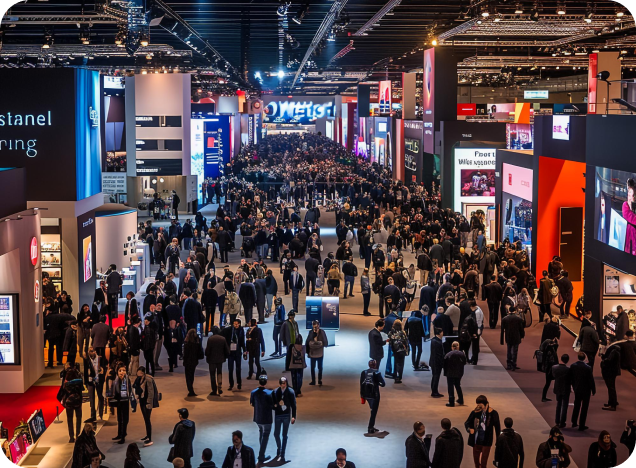
Trade shows represent a high-stakes arena for B2B sales teams and event marketers. Companies invest heavily in booth design, travel, and sponsorships with one singular goal: filling the sales pipeline. Closing an in-person exhibition prospect requires fewer touches and costs significantly less than cold outbound field sales conversions. Trade shows offer a rare opportunity to build immediate, in-person rapport—but that window of opportunity is incredibly fleeting. Despite this massive potential, many exhibitors actively sabotage their success. They rely on archaic processes like paper forms or business card fishbowls.
When your booth is slammed with heavy foot traffic, speed is everything. Writing down lead information on a paper form takes precious minutes; in contrast, scanning a badge takes just seconds. Slow lead capture creates floor bottlenecks, causing high-value prospects to walk away before you can record their information.
To capitalize on foot traffic and justify marketing spend, digital solutions are a competitive necessity. Professional badge scanner apps instantly capture accurate contact data, effectively eliminating the bottlenecks that cost deals.
More importantly, generic scanners merely collect data, but purpose-built apps like OnSpot Social come equipped with built-in lead qualifying capabilities. This crucial feature empowers booth staff to instantly identify which leads are highly qualified and which are just casually browsing. Replacing manual entry with a comprehensive app ensures a seamless, data-rich sales handoff before prospects leave the venue.
II. The Hidden Costs of Pen and Paper at Trade Shows
While the exhibition floor buzzes with potential, your lead capture methodology dictates campaign success. Antiquated processes like paper forms, clipboards, and fishbowls introduce hidden costs that silently eat into ROI. Event marketing specialists know the true cost of a lead includes the operational friction of processing it.
- The Speed and Bottleneck Factor: When a booth is packed with foot traffic, speed is everything. Writing down a prospect’s name, company, email, and specific interests on a paper form takes several minutes per person. In contrast, digital scanners capture that exact data in mere seconds.
Slow, manual capture processes create immediate physical bottlenecks at the booth. This friction causes high-value prospects to walk away to a competitor when they see a line. Furthermore, manual capture eliminates the ability to execute ultra-fast follow-ups.
A Forbes article, Why The Follow-Up Is Everything In Business, notes that firms contacting potential customers within an hour of an inquiry are nearly seven times more likely to qualify that lead than those waiting even an hour longer. Also, they are more than 60 times as likely to qualify the lead compared to companies taking 24 hours or more. If a team relies on manual data entry, hitting these rapid response windows is mathematically impossible. - Compromised Data Integrity: Paper forms inevitably lead to human error. Illegible handwriting, misspelled email addresses, missing critical fields, and the risk of losing physical copies during post-show transit mean exhibitors bleed hard-earned leads. According to industry benchmarks, manual data entry carries an average error rate of 1% to 4% at the field level. This baseline means up to 4 out of every 100 manual data points contain mistakes. When data entry lacks a dedicated verification layer, the error rate frequently sits at that 4% ceiling. If a follow-up email bounces because a handwritten “q” looked like a “g” during transcription, that expensive lead is lost forever.
- The Lethal Follow-Up Delay: Manual data entry takes days to process after an event concludes, creating a costly outreach delay for sales teams. Analysis from ExpoTraffic tracking leads from 12 enterprise SaaS trade shows demonstrated a steep decay curve for lead-to-opportunity conversion based entirely on follow-up timing.
The data shows that leads contacted the same day convert at a rate of 31%. However, if the first outreach is delayed by just 3 to 5 days, the conversion rate plummets to 17%. To put that into perspective, a lead captured on a Tuesday and contacted on a Friday converts at only 60% the rate of a lead contacted on Wednesday morning. Waiting days to manually transcribe paper forms means exhibitors effectively lose deals before outreach even starts. This loss occurs because an attendee’s memory of a booth fades quickly while competitors are already in their inbox.
III. Stop Guessing: The Power of Instant Lead Qualifying
Scanning 500 badges over a bustling three-day exhibition might feel like a massive operational win for booth staff. However, that raw quantity is nothing more than a vanity metric if those names do not convert into revenue. As any veteran sales director will tell you, a massive list of unvetted names is a burden. It is rarely a blessing for a sales team.
If sales reps treat every single scan with the exact same priority, they will inevitably waste valuable hours. In fact, they may chase down students, casual browsers, and competitors while actual buyers go cold.
This is precisely where purpose-built lead capture apps fundamentally change the game. Generic badge scanners and basic event rentals merely act as digital Rolodexes. They collect baseline contact details without context. In contrast, professional tools like OnSpot Social feature built-in lead qualifying to go significantly further.
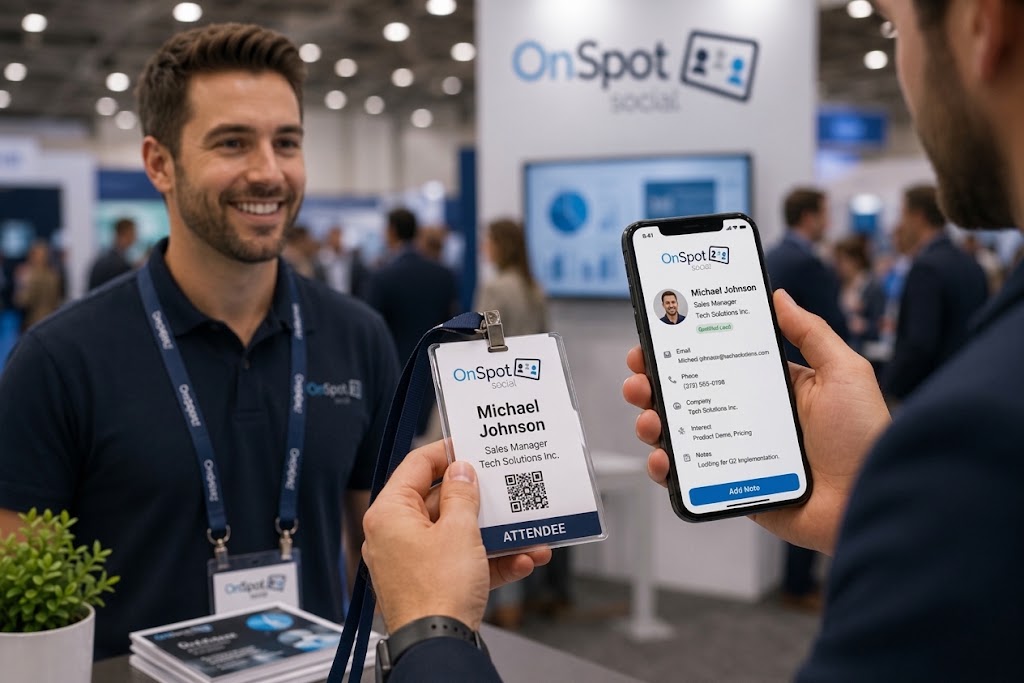
Extracting data is instantaneous when scanning a badge instead of writing lead info on paper forms. Booth staff reclaims valuable minutes to have meaningful conversations. Further, during face-to-face interactions, teams can discreetly use the app to instantly sort out highly qualified leads from casual browsers.
Instead of dumping massive, contextless spreadsheets onto sales teams post-event, staff can seamlessly tag critical buyer intelligence. This happens directly in the app while prospects are still standing there. By utilizing established sales frameworks like BANT, reps can tag a prospect’s:
- Budget: Do they have the allocated funds for your solution?
- Authority: Are they the primary decision-maker, or an influencer?
- Need: What specific pain point brought them to your booth today?
- Timeline: Are they looking to implement a solution this quarter, or next year?
These actionable insights ensure your sales team knows exactly who to prioritize. Imagine your reps opening their CRM on Monday morning and instantly filtering the weekend’s list to surface the 40 “Hot” leads tagged with immediate purchasing authority. That is the power of instant qualification—it transforms trade show chaos into a highly predictable, high-converting revenue pipeline.
IV. Choosing the Right Tool: How OnSpot Social Compares
When equipping your team for an exhibition, lead capture tools vary significantly in quality. Event marketers usually choose among three main options. One option is to rent proprietary hardware directly from event organizers. Alternatively, sales reps can download generic business card scanner apps on personal devices. Finally, companies can invest in a dedicated, centralized lead capture platform.
Renting hardware or using free apps might seem easy. But, piecemeal solutions often cause disjointed data, technical headaches, and heavy administrative burdens. Siloed data and poor data hygiene regularly stem from using inconsistent capture methods. Ultimately, these issues can cost B2B organizations significant revenue through missed opportunities and administrative bloat.
To establish a scalable, efficient process, purpose-built apps offer significantly more flexibility and reliability. Based on direct capability comparisons, here is how OnSpot Social stacks up against traditional event-provided hardware and generic scanner apps:
| Feature | OnSpot Social | Badge Scanners Provided At Events | Business Card Scanner Apps |
| Setup (CRM integration, data formatting, etc.) | One-time | Manual for every event | One-time |
| Capture Versatility | Scans both business cards & badges | No – badges only | No – business cards only |
| Works offline without internet | Yes | Varies | Most do not |
| Built-in Lead Qualifying | Yes | Varies | Most do not |
| Syncs to your CRM | Yes | Varies | Varies |
| Data retrieval/reports | Accessible all the time, in the same format, from the same online reporting portal | Data formatting is different for every event | Limited reports |
| Web-based dashboard | Yes (Manage entire account) | Yes | Most do not |
The Offline Advantage: A Non-Negotiable Necessity
If you manage trade show booths, you already know convention center Wi-Fi is notoriously unreliable. Massive metal booth structures act as Faraday cages blocking cellular signals. Furthermore, network bandwidth overload is a certainty when thousands of attendees connect simultaneously. Thus, relying on a lead capture tool that requires a constant internet connection is a massive operational risk.
OnSpot Social’s robust offline mode serves as a critical safety net. It guarantees your team can continue scanning badges, collecting contact details, and qualifying leads without interruption. It functions smoothly even during a total network blackout. And, the app stores data locally and syncs automatically once a secure connection is re-established.
Unmatched Versatility: Badges and Business Cards
Event-provided scanners only read specific barcodes or QR codes generated for that singular event. Conversely, generic apps only read paper business cards. This limitation creates a critical blind spot for exhibitors.
What happens when meeting a high-value prospect at a post-show networking dinner without their lanyard? What if a VIP attendee’s badge is damaged and unreadable? OnSpot Social bridges this gap by scanning both badges and business cards within the same interface. Consequently, you never miss a lead, regardless of how prospects present their information.
Unified CRM Sync and Streamlined Setup
Renting event scanners often leads to an administrative nightmare: data formatting. Every event organizer uses different registration vendors. As a result, post-show CSV files contain drastically different column headers and structures. Your marketing operations team must then manually clean and map this data before uploading it to your CRM. This process delays sales follow-ups by days.
OnSpot Social eliminates this friction through a true one-time setup. Whether exhibiting at one show or fifty, your data retrieval remains accessible in the exact same format. Everything stays centralized within one online reporting portal. Ultimately, standardizing your data capture and syncing it directly to your CRM ensures clean, uniform lead lists the second the show concludes.
V. Best Practices for Maximizing Your Badge Scanner App
To squeeze every drop of ROI out of your event technology, it is vital to implement operational best practices. The gap between opportunity and execution on the exhibition floor is rarely just a technology problem; it is most frequently a people and process problem.
Train Your Booth Staff on the Transition
A trade show badge scanner is only as powerful as the personnel using it. Many exhibitors make a critical mistake on event morning. Often, they hand a digital tool to their team without establishing a clear conversational protocol.
Train your staff to naturally transition from an organic conversation to scanning a badge. Roleplay the interaction so it feels seamless and professional. This ensures prospects feel valued rather than treated like simple data points. Research from Forrester notes that most B2B buyers expect personalized interactions at exhibits. Your staff must use the scanner to enhance conversations, not abruptly end them
Customize Your Qualifiers Before the Show
Do not settle for generic, out-of-the-box data collection. Before setting foot on the exhibition floor, configure custom qualifying questions directly within your app. Align these qualifiers with established sales frameworks like BANT (Budget, Authority, Need, Timeline). Consequently, your team extracts vital intelligence while speaking face-to-face
Automate the Follow-Up
Because your scanner app syncs directly to your CRM, you can completely eliminate follow-up lag time. Speed to lead is a critical factor in B2B sales success. Often, B2B buyers purchase from whichever vendor responds first to their inquiry.
Capitalize on your CRM integration by setting up automated email sequences. These trigger the exact moment a badge is scanned. When high-value prospects leave your booth and check their phones, a personalized introductory email is already waiting in their inbox.
Conclusion
Trade shows represent one of your company’s most powerful marketing investments. They offer direct, face-to-face access to high-intent buyers. However, event success relies on the leads you capture and your sales follow-up speed.
Relying on outdated methods creates operational bottlenecks that quietly bleed revenue. Deciphering handwritten forms or wrestling with inconsistent scanner rentals slows team progress. To maximize event ROI, you need a streamlined system built for speed, accuracy, and scalability.
Deploying a professional trade show badge scanner app solves key friction points on the exhibition floor:
- Unmatched Speed & Reliability: Replace minute-long paper entries with split-second scans. Eliminate connectivity anxiety with guaranteed offline functionality.
- Context Over Quantity: Move beyond raw contact details using built-in lead qualifying tools. Tag budget, authority, need, and timeline during conversations.
- Seamless Data Hygiene: Standardize data entry across every event. Manage all reporting from a single dashboard and sync leads directly to your CRM.
- Instant Follow-Up Velocity: Automated CRM integration lets you engage prospects within minutes. Secure your position as the first vendor to respond.
Do not let your trade show investment waste away on lost paper forms and cold follow-ups. Equip your team to eliminate manual work, prioritize high-value prospects, and convert floor traffic into measurable sales pipeline
Ready to elevate your event lead generation strategy? Explore how OnSpot Social can streamline your next trade show and turn every interaction into a qualified sales opportunity. Try OnSpot Social today with a FREE trial.
Convention center Wi-Fi is notoriously unreliable, making offline lead collection a necessity. The best solution is a professional lead capture app like OnSpot Social. Its robust offline mode lets your team scan badges and qualify leads without internet access. The app stores data locally and syncs automatically once a secure network is re-established.
The fastest way to qualify event traffic is by replacing manual data entry with a dedicated badge scanner app. Choose a tool with built-in qualifying features to tag prospect needs in real time.
Trade show leads often fail to convert due to delayed follow-ups and poor data integrity. Manual paper forms result in handwriting errors and take days to process. Delaying outreach by 3 to 5 days drops conversion rates from 31% to 17%. Using a digital scanner app ensures instant capture and automated CRM syncing to eliminate this delay.
Renting hardware from event organizers often leads to disjointed data and heavy administrative burdens. Event-provided scanners only read specific badges, and data export formats vary widely between shows.
Conversely, investing in a centralized platform like OnSpot Social provides a single setup and standardized CRM syncing. It also delivers the versatility to scan badges and business cards within the exact same interface.